亞洲🌙 亞洲🌙
遊客
海报背景
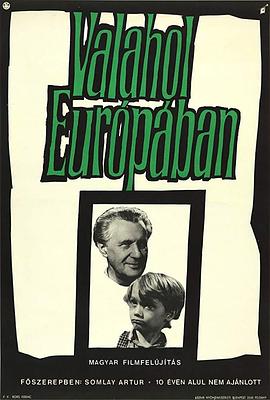
欧洲的某个地方海报图片

欧洲的某个地方

备注 :HD中字
更新 :2025-07-05 11:29:58
1948·其它·剧情 剧情片 电影 ·1948-11-19上映·其它·
立即播放
收藏
8.0
网友评分
  • 很差
  • 较差
  • 还行
  • 推荐
  • 力荐
7.4 101次评分
  • 很差
  • 较差
  • 还行
  • 推荐
  • 力荐
扫描观看

扫描一扫app播放

Somewhere in the remote region, the war ends. In the midst of ruined cities and houses in the streets, in rural hamlets, everywhere where people still live, are children who have lost their homes and parents. Abandoned, hungry, and in rags, defenseless and humiliated, they wander through the world. Hunger drives them. Little streams of orphans merge into a river which rushes forward and submerges everything in its path. The children do not know any feeling; they know only the world of their enemies. They fight, steal, struggle for a mouthful of food, and violence is merely a means to get it. A gang led by Cahoun finds a refuge in an abandoned castle and encounters an old composer who has voluntarily retired into solitude from a world of hatred, treason, and crime. How can they find a common ground, how can they become mutual friends The castle becomes their hiding place but possibly it will also be their first home which they may organize and must defend. But even for this, the price will be very high.  To this simple story, the journalist, writer, poet, scriptwriter, movie director, and film theoretician Béla Balázs applied many years of experience. He and the director Géza Radványi created a work which opened a new postwar chapter in Hungarian film. Surprisingly, this film has not lost any of its impact over the years, especially on a profound philosophical level. That is to say, it is not merely a movie about war; it is not important in what location and in what period of time it takes place. It is a story outside of time about the joyless fate of children who pay dearly for the cruel war games of adults.  At the time it was premiered, the movie was enthusiastically received by the critics. The main roles were taken by streetwise boys of a children's group who created their roles improvisationally in close contact with a few professional actors, and in the children's acting their own fresh experience of war's turmoil appears to be reflected. At the same time, their performance fits admirably into the mosaic of a very complex movie language. Balázs's influence revealed itself, above all, in the introductory sequences an air raid on an amusement park, seen in a montage of dramatic situations evoking the last spasms of war, where, undoubtedly, we discern the influence of classical Soviet cinematography. Shooting, the boy's escape, the locomotive's wheels, the shadows of soldiers with submachine guns, the sound of a whistle—the images are linked together in abrupt sequences in which varying shots and expressive sharp sounds are emphasized. A perfectly planned screenplay avoided all elements of sentimentality, time-worn stereotypes of wronged children, romanticism and cheap simplification. The authors succeeded in bridging the perilous dramatic abyss of the metamorphosis of a children's community. Their telling of the story (the scene of pillaging, the assault on the castle, etc) independently introduced some neorealist elements which, at that time, were being propagated in Italy by De Sica, Rossellini, and other film artists. The rebukes of contemporary critics, who called attention to formalism for its own sake have been forgotten. The masterly art of cameraman Barnabás Hegyi gives vitality to the poetic images. His angle shots of the children, his composition of scenes in the castle interior, are a living document of the times, and underline the atmosphere and the characters of the protagonists. The success of the picture was also enhanced by the musical art of composer Dénes Buday who, in tense situations, inserted the theme of the Marseilaise into the movie's structure, as a motive of community unification, as an expression of friendship and the possibility of understanding.  Valahol Europaban is the first significant postwar Hungarian film. It originated in a relaxed atmosphere, replete with joy and euphoria, and it includes these elements in order to demonstrate the strength of humanism, tolerance, and friendship. It represents a general condemnation of war anywhere in the world, in any form.
展开
无模块

资源列表

排序

相关明星

相关影片

更多
爱的不确定性原理
卡罗琳·彼得斯,布尔格哈特·克劳斯纳,卡门-玛雅·安东尼
千面情踪
ഫെയ്സസ്
阿喀琉斯归来
George Tounas,Jannis Sky,C. Dan,Kristina Lafser
无界之环
你的敵人不是你的敵人(台)
阿拉贝拉的绑架
The Kidnapping of Arabella
天子传奇洪武大帝
天子传奇:洪武大帝 AI漫剧版
坠落也无妨
Glaiza De Castro , Rhian Ramos
热血篮球之永不放弃
教练白海冰,因一场意外尘封篮球梦。为完成病危师兄的嘱托,他接手一支被嘲为“无胜利队”的业余球队。当一群问题少年遇上背负阴影的教练,他们面对的是强队的碾压与全网的嘲讽。但这次,他们选择用血汗撕掉废物的标签。当终场哨响,奇迹只属于永不放弃的人。
麦迪的秘密
约翰·厄尔利,Kip Reynolds,Neil Wachs,Harris Mayersohn
女孩们女孩们
Kya-Celina Barucki,Julia Novohradsky,Nhung Hong
逝水与流年
安德烈·斯奈·马格纳森,Árni Kjartansson,赫迪斯·斯特芬斯多蒂尔,Hulda Filippusdóttir
毒战行动
断罪 / 无间毒票3:断罪 / 无间毒票:断罪
内华达之瑰
谜航(台),英伦转生号(港),内华达玫瑰
陵水之恋
该片是一部聚焦陵水黎族文化传承与滨海旅游资源的现实题材电影,以“山海相恋·文化铸魂”为核心主题,通过细腻的叙事展现陵水黎族织锦、疍家渔歌等非遗文化魅力,同时呈现分界洲岛、清水湾等标志性旅游景观,展现陵水自然与人文交融的独特魅力。
  • 片名:欧洲的某个地方
  • 状态:HD中字
  • 主演:Artúr Somlay Miklós Gábor Zsuzsa Bánki 
  • 导演:Radványi Géza 
  • 年份:1948
  • 地区:其它
  • 类型:剧情 剧情片 电影 
  • 频道:内详
  • 上映:1948-11-19
  • 语言:其它
  • 更新:2025-07-05 11:29
  • 简介:Somewhere in the remote region, the war ends. In the midst of ruined cities and houses in the streets, in rural hamlets, everywhere where people still live, are children who have lost their homes and parents. Abandoned, hungry, and in rags, defenseless and humiliated, they wander through the world. Hunger drives them. Little streams of orphans merge into a river which rushes forward and submerges everything in its path. The children do not know any feeling; they know only the world of their enemies. They fight, steal, struggle for a mouthful of food, and violence is merely a means to get it. A gang led by Cahoun finds a refuge in an abandoned castle and encounters an old composer who has voluntarily retired into solitude from a world of hatred, treason, and crime. How can they find a common ground, how can they become mutual friends The castle becomes their hiding place but possibly it will also be their first home which they may organize and must defend. But even for this, the price will be very high.  To this simple story, the journalist, writer, poet, scriptwriter, movie director, and film theoretician Béla Balázs applied many years of experience. He and the director Géza Radványi created a work which opened a new postwar chapter in Hungarian film. Surprisingly, this film has not lost any of its impact over the years, especially on a profound philosophical level. That is to say, it is not merely a movie about war; it is not important in what location and in what period of time it takes place. It is a story outside of time about the joyless fate of children who pay dearly for the cruel war games of adults.  At the time it was premiered, the movie was enthusiastically received by the critics. The main roles were taken by streetwise boys of a children's group who created their roles improvisationally in close contact with a few professional actors, and in the children's acting their own fresh experience of war's turmoil appears to be reflected. At the same time, their performance fits admirably into the mosaic of a very complex movie language. Balázs's influence revealed itself, above all, in the introductory sequences an air raid on an amusement park, seen in a montage of dramatic situations evoking the last spasms of war, where, undoubtedly, we discern the influence of classical Soviet cinematography. Shooting, the boy's escape, the locomotive's wheels, the shadows of soldiers with submachine guns, the sound of a whistle—the images are linked together in abrupt sequences in which varying shots and expressive sharp sounds are emphasized. A perfectly planned screenplay avoided all elements of sentimentality, time-worn stereotypes of wronged children, romanticism and cheap simplification. The authors succeeded in bridging the perilous dramatic abyss of the metamorphosis of a children's community. Their telling of the story (the scene of pillaging, the assault on the castle, etc) independently introduced some neorealist elements which, at that time, were being propagated in Italy by De Sica, Rossellini, and other film artists. The rebukes of contemporary critics, who called attention to formalism for its own sake have been forgotten. The masterly art of cameraman Barnabás Hegyi gives vitality to the poetic images. His angle shots of the children, his composition of scenes in the castle interior, are a living document of the times, and underline the atmosphere and the characters of the protagonists. The success of the picture was also enhanced by the musical art of composer Dénes Buday who, in tense situations, inserted the theme of the Marseilaise into the movie's structure, as a motive of community unification, as an expression of friendship and the possibility of understanding.  Valahol Europaban is the first significant postwar Hungarian film. It originated in a relaxed atmosphere, replete with joy and euphoria, and it includes these elements in order to demonstrate the strength of humanism, tolerance, and friendship. It represents a general condemnation of war anywhere in the world, in any form.
视频
搜索历史
删除
热门搜索
本地记录 云端记录
登录账号